
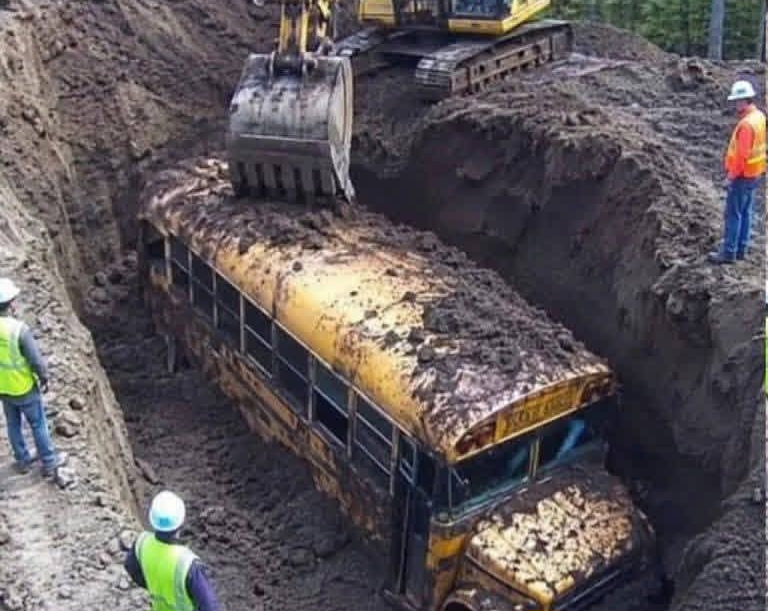
For nearly four decades, the people of Hallstead County lived with a question that had never been answered:
What happened to the 15 children who disappeared on a school field trip in the spring of 1986?
That morning had started like any ordinary school day.
Fifteen children climbed aboard a yellow school bus, laughing and talking as they prepared for a field trip to Morning Lake. A teacher accompanied them, along with the driver.
They were supposed to return home that afternoon.
They never did.
The bus disappeared without a trace.
Search teams spent days combing the surrounding roads, forests, fields, and waterways. Helicopters flew overhead. Volunteer rescuers searched through the woods. Divers explored nearby waters. Tracking dogs were brought in.
But nothing was found.
No wreckage.
No belongings.
No bodies.
No explanation.
Over the years, countless theories emerged.
Some believed the bus had crashed into Morning Lake. Others thought the children had been victims of an accident that had somehow remained hidden. A few theories were darker, suggesting that someone had deliberately made them disappear.
But without evidence, the case eventually went cold.
The children were officially classified as missing and presumed lost.
Then, almost forty years later, everything changed.
The Discovery
Shortly after seven o’clock one morning, a construction crew was working near an area known as Morning Lake Pines.
They were digging the foundation for a septic system when one of the workers suddenly felt the excavator strike something solid.
At first, they assumed it was an old piece of farm equipment.
Then they saw yellow paint beneath the dirt.
The workers stopped immediately.
As they carefully removed more soil, the unmistakable shape of a school bus began to emerge.
The discovery was reported to the authorities.
When Deputy Sheriff Lana Whitaker arrived, she immediately recognized the significance of what was being uncovered.
She had spent years knowing about the disappearance.
But for Lana, the case was far more personal than it was for most investigators.
She had been a child in Hallstead County in 1986.
In fact, she had been scheduled to go on that very same field trip.
But a sudden illness had kept her home.
She remembered standing at her bedroom window and watching the school bus leave.
She remembered seeing some of the children inside.
She remembered waving.
And she remembered something even more painful:
They never came home.
Now, nearly forty years later, she was standing in front of the same bus.
Frozen in Time
By the time investigators arrived, the workers had uncovered only part of the vehicle.
Much of the bus remained buried beneath layers of soil.
The emergency exit was open.
Inside, investigators discovered a scene that seemed frozen in another era.
Dust covered the seats.
Old seat belts still hung from their mounts.
A faded pink lunchbox was lying beneath one of the seats.
Near the rear exit was a single child’s shoe.
Nature had slowly reclaimed the vehicle.
Roots had grown around parts of the frame.
Dirt covered the windows.
But there was one detail that immediately shocked investigators.
There was nobody inside.
No children.
No driver.
No teacher.
Not even human remains.
The bus was completely empty.
And then Deputy Whitaker noticed something on the dashboard.
An old class roster.
The names of all fifteen children were still listed.
But beneath the names, written in faded red marker, was a sentence that sent chills through the investigation team:
“We never made it to Morning Lake.”
For nearly forty years, investigators had believed the children had disappeared along the route to the lake.
But the message suggested something completely different.
If the message had been written by someone inside the bus, then perhaps the children had never reached their destination.
And if someone had written it after the bus disappeared…
Who had returned to the bus?
The Old Case Files
Lana returned to the county archives and began reviewing the original investigation.
Box after box contained photographs, maps, witness statements, newspaper articles, and search reports.
The documents revealed just how enormous the original search had been.
Helicopters had searched the surrounding wilderness.
Rescue teams had walked miles through the forest.
Divers had searched the lake.
Dogs had followed possible trails.
Hundreds of people had participated in the search.
Yet nothing had ever explained what happened.
There had been no confirmed crash.
No confirmed sighting after the disappearance.
No evidence that could explain where the children had gone.
And now, after all those years, the missing bus had finally been found.
But instead of solving the mystery, it created even more questions.
The Mystery Deepens
Investigators carefully examined the vehicle.
The bus had clearly been buried for a very long time.
But the emergency exit was open.
The class roster was still on the dashboard.
The child’s shoe remained near the rear of the bus.
And someone had written a message that appeared to contradict the original theory.
If the bus had crashed, where were the children?
If they had left the vehicle, where did they go?
Why was the bus buried?
Who had placed the message on the dashboard?
And perhaps the most disturbing question of all:
How long had someone known where the bus was?
Lana Whitaker reportedly spent hours studying the old maps from 1986.
The location where the bus had been discovered was not exactly where investigators had focused their original search.
The landscape had changed dramatically over four decades.
Trees had grown.
Old roads had disappeared.
Property boundaries had changed.
What had once been accessible countryside was now heavily overgrown.
The possibility emerged that the bus had been hidden in an area that search teams simply never reached.
But that still didn’t explain the message.
A Case Reopened
The discovery forced authorities to reconsider the entire disappearance.
The old case, once considered one of Hallstead County’s most heartbreaking unsolved mysteries, was officially reopened.
Modern investigators began examining the original evidence using technology that had not existed in 1986.
Old photographs were digitized.
Archived interviews were reviewed.
The bus itself was examined for fingerprints, traces of biological material, markings, and other evidence that might have survived decades underground.
Meanwhile, investigators began searching for people who might have known something at the time but had never spoken publicly.
For the families of the missing children, the discovery brought a mixture of hope and pain.
For decades, they had lived without knowing what happened to their sons, daughters, brothers, and sisters.
Now, for the first time in almost forty years, they finally had something tangible.
The bus.
The vehicle everyone had searched for.
The vehicle that had vanished along with fifteen children.
But the greatest mystery remained unsolved.
Where were the children?
The Question That Remains
The discovery of the bus changed everything.
For decades, people had believed that finding the vehicle would finally provide the answers.
Instead, it created an even bigger mystery.
The bus was there.
The children were not.
The driver was not.
The teacher was not.
And someone had left behind a message claiming:
“We never made it to Morning Lake.”
Was it a desperate message written by one of the children?
Was it written by someone else?
Was the message genuine?
Or was it deliberately placed there decades later to mislead investigators?
Until those questions are answered, the disappearance of the fifteen children remains one of Hallstead County’s darkest mysteries.
And for Deputy Lana Whitaker, the discovery is deeply personal.
She was supposed to be on that bus.
A childhood illness kept her home that morning.
Nearly forty years later, she was the one standing beside it when it finally emerged from the ground.
She had watched the bus disappear in 1986.
Now she had watched it return.
But the people inside it were still missing.
And somewhere beneath the silence of those four decades may still be the answer to the question that has haunted Hallstead County for generations:
What really happened to the fifteen children who never came home?
Note: This story is written in a fictional mystery/viral-story style. If you publish it as factual true crime, verify the names, location, date, and discovery against reliable sources first.