
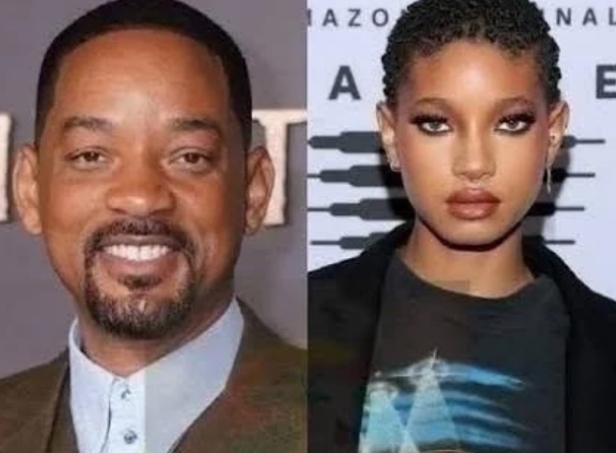
Will Smith’s Daughter ‘Breaks Her Silence’? The Truth Behind the Headline Taking the Internet by Storm
One dramatic headline was enough to send social media into a frenzy.
“Will Smith’s daughter finally breaks her silence…”
But silence about what?
That was the question thousands of people were left asking after the mysterious headline began spreading online. The wording seemed to promise a shocking revelation, a family secret, or perhaps a bombshell statement that Hollywood had been waiting to hear.
There was just one problem.
The headline gave readers almost no actual information.
And that may have been exactly the point.
The Headline That Made Everyone Curious
In the world of viral content, curiosity can be more powerful than facts.
Phrases such as “breaks her silence,” “finally speaks out,” “what she revealed shocked everyone,” and “you won’t believe what happened next” are designed to create one powerful feeling: I need to know.
You click because the story feels incomplete.
You keep reading because you expect a dramatic revelation.
And before you know it, you’ve shared a story whose original source may be difficult to find.
The viral headline involving Will Smith’s daughter followed this familiar formula. It suggested that something important had finally been revealed, but the headline itself didn’t clearly explain what had supposedly happened.
That missing information created the perfect curiosity gap.
But Did She Actually Reveal a Bombshell?
This is where the story becomes much less dramatic—and much more important.
There is a major difference between a celebrity openly discussing personal experiences and a celebrity confirming a sensational rumor circulating online.
Willow Smith has spoken publicly over the years about personal growth, creativity, mental health, relationships, and the unusual pressures that come with growing up in a famous family.
Because she has been candid about aspects of her life, sensational stories involving her can sometimes appear believable.
But believable isn’t the same thing as verified.
At the time of writing, there is no reliable public evidence establishing the dramatic revelation suggested by the viral teaser.
No verified full quotation.
No clearly identified interview confirming the claim.
No official statement providing the context promised by the headline.
And that’s an important distinction.
Why These Stories Spread So Quickly
Imagine seeing this on your phone:
“Will Smith’s daughter finally breaks her silence—and what she said has everyone talking…”
Your brain immediately wants to complete the unfinished story.
What did she say?
Who was she talking about?
What happened?
Why hasn’t anyone told me?
That psychological reaction is known as the curiosity gap.
The less information a headline gives you, the stronger the temptation can become to click in order to close that gap.
The strategy isn’t necessarily to give you the truth immediately.
It’s to make you curious enough to keep reading.
The Biggest Warning Sign
There is one simple question that can save you from falling for countless viral stories:
“Where is the original source?”
If a post contains a shocking celebrity claim but doesn’t provide a complete interview, a credible publication, a direct statement, or another verifiable source, stop before sharing it.
Search for the exact quote.
Look for the original interview.
Check when the story was published.
Then compare it with several reputable sources.
If the dramatic claim appears only on obscure websites repeating one another, that’s a major warning sign.
Don’t Let a Headline Tell You What to Think
A headline is not the entire story.
Sometimes an old interview is presented as breaking news.
Sometimes a harmless comment is removed from its original context.
Sometimes a celebrity’s words are shortened so dramatically that the meaning changes completely.
And sometimes the headline promises a revelation that the article never actually proves.
That’s why reading beyond the headline matters.
The first few seconds of curiosity should not determine what you believe.
The “Breaks Her Silence” Trap
There is another clue worth remembering.
Whenever you see phrases like:
“finally breaks her silence”
“admits the truth”
“reveals the secret”
“confession shocks fans”
“you won’t believe what she said”
take a moment before clicking Share.
These phrases aren’t proof that a story is false.
But they are strong signals that the headline may be optimized for attention rather than clarity.
A trustworthy story should be able to explain what happened without hiding the essential information behind a dramatic teaser.
What We Actually Know
The safest conclusion is surprisingly simple.
Willow Smith has publicly discussed real and sometimes deeply personal subjects throughout her career.
That doesn’t mean every sensational story attached to her name is true.
And it certainly doesn’t mean that a mysterious viral headline should automatically be treated as confirmation of a family controversy.
The absence of verified evidence matters.
Until a significant claim is supported by a reliable source and presented with its full context, it should remain exactly what it is:
an unverified internet claim.
Before You Share the Next Viral Celebrity Story…
Try this five-second test:
Stop.
Read beyond the headline.
Find the original source.
Check the date.
Look for independent confirmation.
If you still can’t establish what actually happened, don’t share it.
You aren’t missing out.
You’re simply refusing to let a clickbait headline make the decision for you.
The Real Lesson Behind the Viral Story
Perhaps the most interesting part of this entire episode isn’t whether a celebrity “broke her silence.”
It’s how quickly millions of people can become emotionally invested in a story before they even know what the story is.
That’s the power of modern headlines.
They don’t always need to tell you something shocking.
Sometimes they only need to make you believe something shocking is waiting behind the click.
So the next time you see a headline about a celebrity that makes you gasp, stop for a moment.
Take a breath.
Ask yourself:
“Do I know what actually happened—or am I reacting to what the headline wants me to imagine?”
Because in an internet filled with rumors, outrage, and endless speculation, one thing remains incredibly valuable:
the ability to pause before believing.
And sometimes, the most surprising revelation isn’t hidden inside the story at all.
It’s discovering how easily a headline can make us believe there must be a story.